Is Your Canthal Tilt Positive or Negative?
Find out whether your eyes tilt up, down or neither, from one ordinary photo. The test levels your head before it measures, reads each eye in degrees, and shows how much head tilt it leveled.
Free while in beta, no app needed. The measuring runs on your own device.
Analyze your face
Measured from 478 facial landmarks with fixed formulas. Runs entirely in your browser.
What you get back
One photo in, a reading for each eye out. This is a real run on the example face: the figures below are what the tool actually returned for it.

- Average of both eyes
- +5.4°
- Left eye
- +5.3°
- Right eye
- +5.5°
- Difference
- Right eye 0.2° higher
- Head tilt found and leveled
- 2.8°
- Before leveling, left / right
- +8.1° / +2.7°
The average is the number everyone quotes; the rest is what makes it trustworthy. Her head is tilted 2.8° in this photo. Measured straight against the edge of the photo, her eyes read +8.1° and +2.7°, a 5.4° difference that is almost entirely the tilt. So the tool first finds the face's own horizontal from twelve pairs of matching points on either side (cheekbones, jaw, mouth corners, nostrils, brows), turns the face level, and only then measures: +5.3° and +5.5°. The average is the same either way, because a tilt adds to one eye exactly what it takes from the other. The accuracy section below shows the leveling working on 29 portraits.
How to measure canthal tilt
Canthal tilt is the angle of the line from the inner corner of the eye to the outer corner, measured against a level horizontal. You can do this by hand before you trust a tool with it. Two points and a line are all it takes.
1.Take a level, front-facing photo
Eye level, straight at the camera, head level. This step matters more than any later one, and the accuracy section explains exactly how much.
2.Find the two corners of one eye
The inner corner, where the lids meet beside the nose, is the medial canthus. The outer corner, toward the temple, is the lateral canthus. Mark both.
3.Measure the line against the horizontal
Draw a line through the two corners and read its angle against a horizontal line. Outer corner higher than the inner one is a positive tilt; lower is negative. Repeat on the other eye.
The tool does the same thing with less guesswork about where the corners are. It places 478 landmark points on the face with Google's MediaPipe face landmark model, which runs in your browser, and takes the two that sit on the inner and outer corner of each eye. Before measuring, it levels the face: it finds the face's own horizontal from twelve pairs of matching points on the left and right side, leaving out the eye corners themselves, and turns the points so that line is flat. The angle between each eye's corner line and that level horizontal is the reading. That is the whole calculation; there is no model deciding what your tilt should be.
Two details are worth knowing. The horizontal is calculated from your face's own geometry. Using the edge of the photo instead would add about 4° to the difference between your two eyes' readings when the head is tilted sideways by just 2°. And each eye is measured on its own with the same formula, so the two readings are directly comparable and their difference means something.
Positive, neutral and negative canthal tilt: what each looks like
Three words for three directions of the same line. They describe which corner sits higher, nothing more.
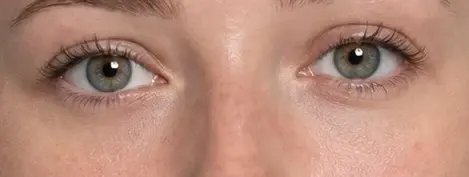
Positive canthal tilt +5.4°
Original photo
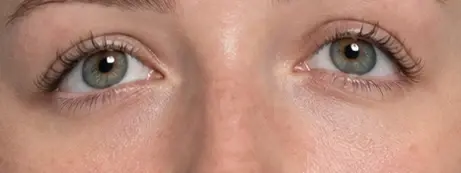
Neutral canthal tilt −0.4°
Edited: outer corners moved
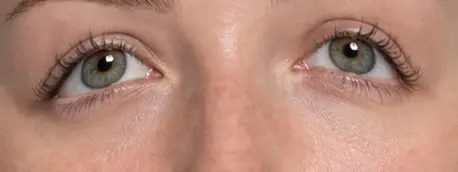
Negative canthal tilt −2.5°
Edited: outer corners moved
Positive canthal tilt
The outer corner sits higher than the inner corner, so the eye appears to lift toward the temple. This is the direction most reference ranges for adults fall in, by a few degrees.
Neutral canthal tilt
The two corners sit at roughly the same height and the line runs close to level. This tool calls anything within one degree of level neutral, and says so on the result because that boundary is a convention.
Negative canthal tilt
The outer corner sits lower than the inner corner, so the eye appears to slope downward toward the temple. It is common, it is measurable, and what it means is a separate question this page takes up further down.
The labels are a convention. Where neutral ends and positive begins is not something a face decides; it is a line someone drew. The tool shows the degrees next to the label so you can ignore the label if you prefer.
Why eyes can look downturned with a positive canthal tilt
Canthal tilt is the angle of a line between two points. What people usually mean when they call an eye downturned is the shape between those points: an upper lid that sits low over the outer third of the eye, or a lower lid that dips toward the temple before it turns up to meet the corner. Both change how the eye reads at a glance, and neither moves the two corners the tilt is measured from.
Lids follow the corners
Upper lid slopes down
Real faces show the same split. We ran eleven "before" photos from eyelid and canthoplasty surgery galleries through this tool, chosen because the eyes in them look downturned. Every one measured a positive tilt, from +2.5° to +10.6°, with a median of +4.7°. The 29 ordinary portraits used elsewhere on this page have a median of +4.4°. Judged by their corner lines, the downturned-looking eyes were ordinary.
The lids can still nudge the number. The landmark model places each corner partly from the shape of the lids around it, so a heavy upper lid or a sloping lower lid can pull a reading down somewhat. Even so, all eleven surgery photos still measured a positive tilt on this tool.
If your eyes look downturned to you and the tool reads a positive or neutral tilt, the lids are the likelier explanation. Your result draws the outline of both eyelids next to the corner line, so you can see whether your eyelids slope down while the corner line tilts up.
Typical canthal tilt for men and women
Most published figures agree on the direction and disagree on the exact numbers. A commonly quoted set of reference ranges puts men at roughly 0° to +4° and women at roughly +2° to +8°, with women averaging a couple of degrees more than men. A 2023 study that measured 100 facial points on 42 celebrities reported 8.5° for the women and 6.5° for the men, and cited a general-population figure of about 4°.
The gap between the sexes shows up in every source; the absolute numbers do not. That is expected: each study places the corner points its own way, on its own photographs, with its own way of leveling the head, so the numbers do not transfer between them cleanly. Treat any single range as one measurement convention, shaped by how that particular study measured.
What this tool reads on real photographs
Run on 29 official portrait photographs, this tool's average of both eyes had a median of 4.4°, with the middle half of the portraits between 3.3° and 5.3° and the full spread from −0.1° to 10.1°. Twenty-nine faces are not a population and the page does not report a percentile, but they are enough to show where ordinary adult faces land on this particular tool.
How accurate is this canthal tilt number?
Two different questions hide in that one. Is the number right for this photo? Yes: the tool is deterministic, so the same file returns the same degrees every time, and the corner points it uses are the ones marked on your photo. Is the number right for your face? Only as far as the photo is a fair view of it, and for canthal tilt that caveat is bigger than for most measurements: a slightly tilted or lowered head moves the reading by degrees, on the same scale as the thing being measured.
The reason is scale. The entire range of ordinary adult faces spans about ten degrees, and the gap people argue about, between a slightly positive and a slightly negative tilt, is two or three degrees. We measured how much each kind of head movement shifts the reading, on 29 real photographs. One of them, a sideways head tilt, can be corrected exactly from the photo itself, and the tool does that automatically. The others are checked and estimated, and your result tells you by how much.
What moves the number, measured on 29 real photographs
Head roll: 2° of left-right difference per 1° of roll, leveled automatically
Tilting the head sideways raises one eye's outer corner and lowers the other's. Measured against the edge of the photo, across 29 portraits, each degree of roll moved the left-right difference by 2.0° (±0.1°), almost exactly the geometric prediction, while the average of both eyes barely moved (0.03° per degree). The tool levels the face along its own horizontal before measuring, found from 12 matching point pairs on the cheekbones, jaw, mouth, nose and brows, which keeps the eye corners out of it. After leveling, the difference no longer follows the roll (0.00° ± 0.08° per degree). Your result shows how many degrees of tilt it found and leveled.
Head pitch: about 0.25° per 1° of nod, estimated for your photo
Dropping the chin lowered the average reading by roughly 0.25° per degree of pitch (±0.1°). That figure comes from comparing 29 different faces photographed at slightly different pitches, so treat it as a rough estimate. A ten-degree nod, easy to do without noticing, shifts the reading by about 2.5°, more than half the quoted range for men. One photo holds too little depth information to undo a nod reliably, so the tool estimates it instead: the photo check under your result says how far your head looks tipped compared with a typical straight-on portrait, and roughly how much higher or lower your actual tilt probably is.
Head turn: no detectable effect on the average, checked on every photo
Turning the head left or right, within the ±11° present in those portraits, produced no measurable shift in the average (0.03° ± 0.13° per degree). Any effect is smaller than the typical spread between different faces in the same set, about 2.5°. The photo check under your result shows the turn the tool detected and flags it when it goes beyond the ±11° we tested.
Left-right difference: mostly head tilt before leveling, about a degree after
Measured against the edge of the photo, portraits with less than 2° of roll had eyes that differed by 1.9° on average, 6.5° between 2° and 4° of roll, and 11.4° above 4°. After leveling, the average difference in the same three groups was 1.2°, 1.1° and 1.6°, so the tilt no longer drives it. Part of what remains comes from the tool itself: in 27 of the 29 portraits the subject's left eye read slightly higher, by 1.2° on average, and real asymmetry would not lean one way that consistently. Treat a leveled difference of about a degree as within the tool's resolution.
Repeatability: about ±1°, which sets the neutral band
Re-analyzing the same photo rotated by ±3° moved the average by about 0.5° typically and 1.4° at most. That noise comes from the face detector placing each corner a pixel or two differently on each pass. One photo resolves canthal tilt to about ±1°, so readings within 1° of level are called neutral.
What this means in practice. The tool levels head tilt, the largest source of error, before it measures, and your result shows how much it found. It checks head turn, estimates the effect of a nod or a high or low camera, and tells you whether your positive, neutral or negative verdict still holds with those allowed for. A photo taken at eye level, facing the camera, still gives the cleanest reading, and only photos taken the same way are worth comparing. An ordinary selfie is usually good enough; when it is not, the photo check says so.
Photos turned, tilted or nodded by more than 25° are refused, because the landmarks stop being reliable at that angle. Between 15° and 25° the tool still gives a reading and marks it low confidence. Within 15° it reads normally: head tilt is leveled and everything else is reported in the photo check.
Why your left and right eyes read differently
Almost everyone gets two different numbers. A tilted head is the usual cause of a large left-right difference: it raises one outer corner and lowers the other, so a 2° sideways tilt alone accounts for about 4° between the eyes. This tool removes that before measuring by leveling the face along its own horizontal, and the note under your result shows the difference before and after. Across 29 portraits, what remained after leveling averaged about a degree, and part of that is the tool itself: most of those portraits read slightly higher on the left eye, a consistent offset that real faces would not share. A difference of a degree or so is within what one photo can resolve.
A clearly larger left-right difference on a leveled photo is more likely to be real. Faces are not symmetrical, and the eye corners are one of the more stable places that shows up: the outer corners sit at slightly different heights on most people, and the difference is repeatable from photo to photo when the head is held the same way. It is the same asymmetry the face symmetry test on this site measures across the whole face, and a difference of a degree or so at the eyes is ordinary.
Two things do not follow from a difference between your two eyes' readings. It does not mean one measurement is wrong, and it does not mean something needs correcting. Most people cannot see a one-degree difference in another person's eyes at conversational distance; the composite images on the symmetry page, which double every difference, are the only way most people ever notice their own.
Measure the rest of your facial symmetryWhy canthal tilt became an online obsession
Canthal tilt was a measurement in surgical and anthropometric studies long before it was a screenshot. What changed is who started measuring it, and why.
2007
A study in Ophthalmic Plastic and Reconstructive Surgery digitally accentuated the canthal tilt on a set of female faces and asked judges to pick the more attractive version. They chose the accentuated one 93% of the time: with everything else about the face held equal, people respond to the direction of the tilt.
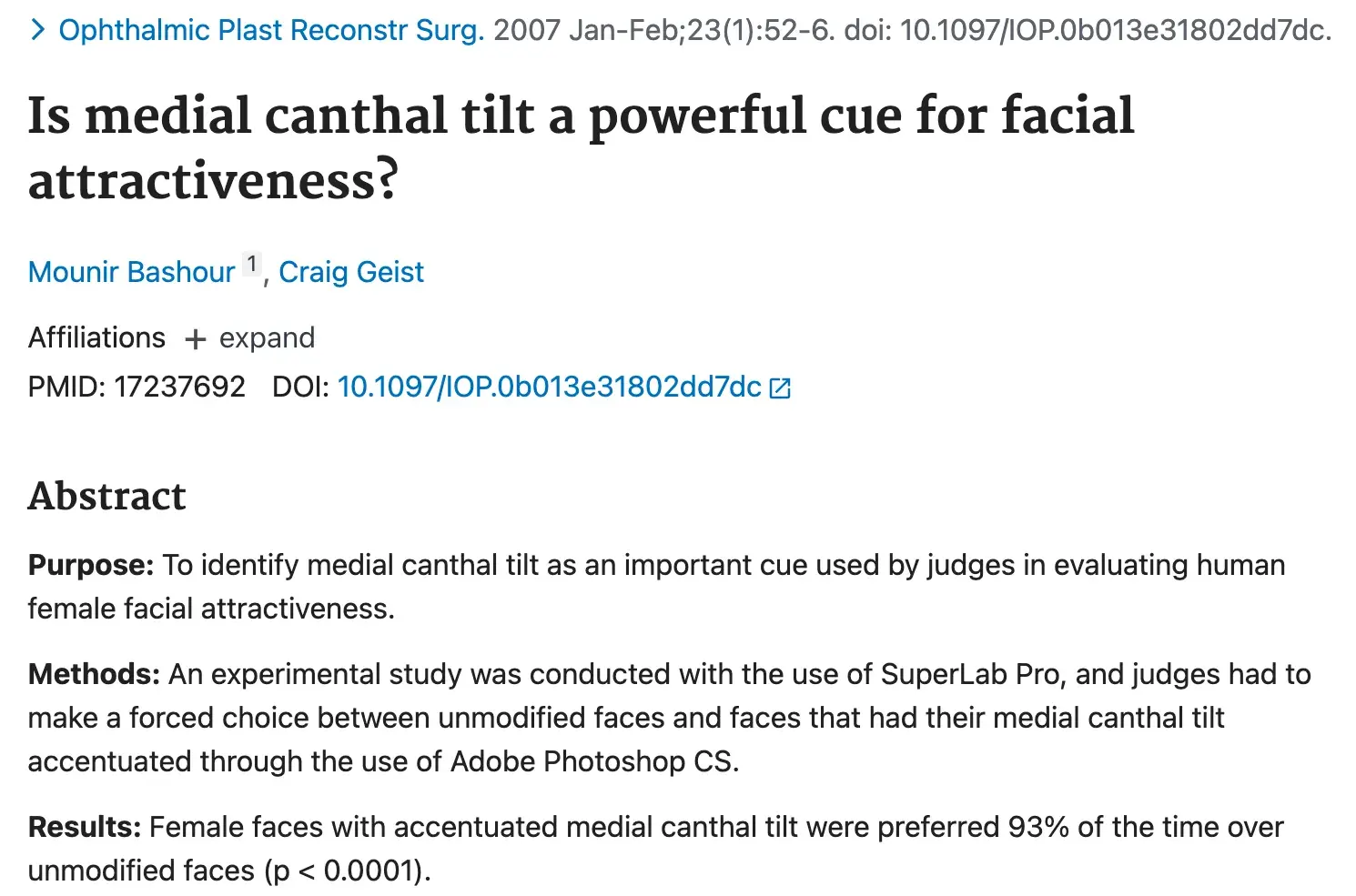
Bashour and Geist, 2007. Abstract on PubMed. By 2019
Looksmaxxing forums had already made canthal tilt a fixed topic, with threads asking how to measure it and arguing where "positive" starts. The angle had moved out of surgical literature and into a community that scores faces.
2020
The fox-eye look, created with makeup, tape or a lateral brow lift, went viral and pushed canthal tilt toward the mainstream. It also drew criticism for turning a feature widely associated with East Asian eyes into a trend, a controversy that followed the look into its TikTok phase.

Brianna Fox, fox-eye makeup tutorial on YouTube. August 2023
A TikTok filter that draws the eye-corner line made canthal tilt something anyone could screenshot and argue about. Plastic surgeons were asked to explain what the term meant. Some of the loudest commenters treated a negative tilt as disqualifying, with lines like "Negative canthal tilt, it's over for bro," while the surgeons interviewed pushed back on that reading.
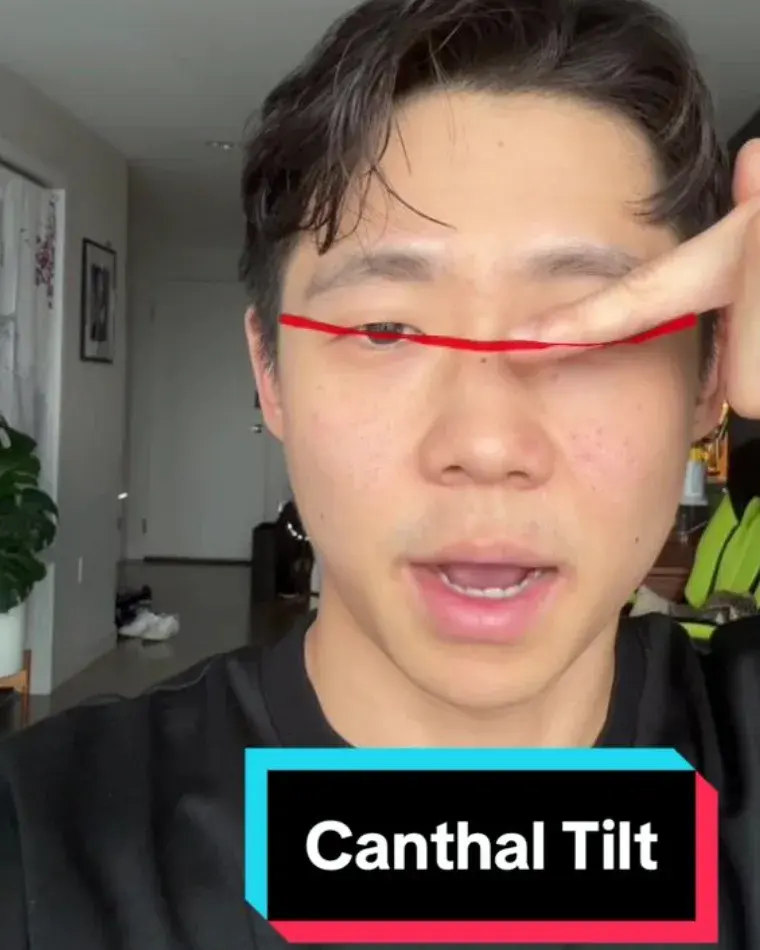
Chris P., MD (@chrisp.md) on TikTok. Later in 2023
The same filter found a second use as a guide for painting a straighter eyeliner wing.
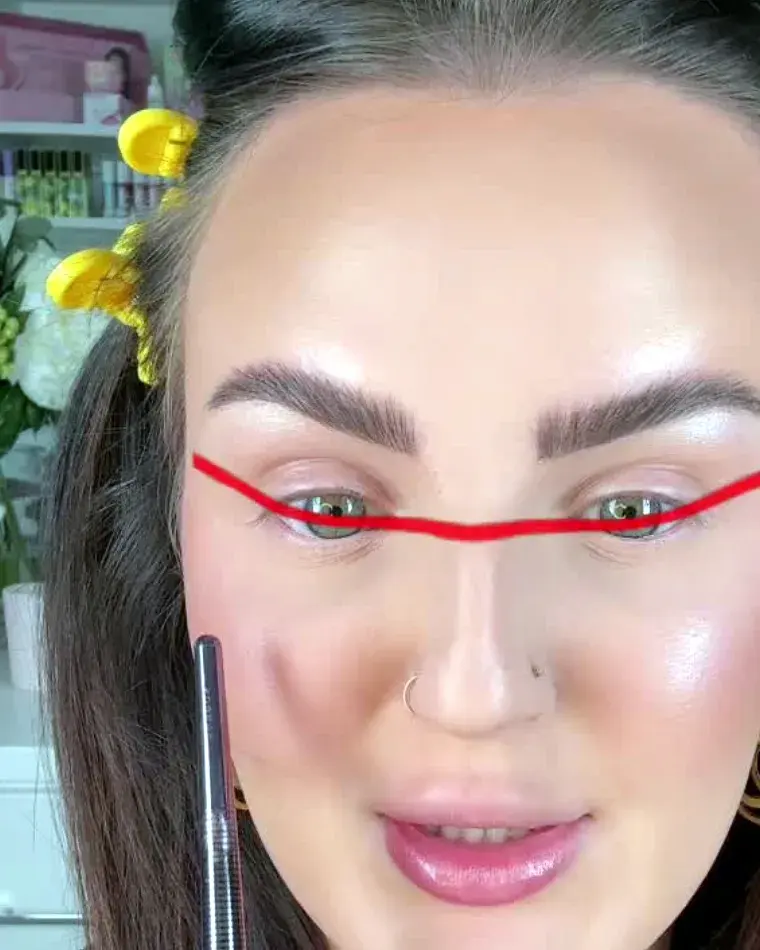
Mikayla Nogueira (@mikaylanogueira) on TikTok.
The surgeons asked about the trend kept coming back to one point. Ramtin Kassir, MD, a triple board-certified facial plastic and reconstructive surgeon, told Glamour: "Attractiveness is highly subjective and can vary significantly from person to person... There is no one-size-fits-all standard." The trend looks at one thing: the line joining the inner and outer corner of each eye. The tool on this page measures that same line and also checks how far the photo it came from can be trusted.
Is a negative canthal tilt a defect?
If the tool read −2.3° for you, with the two eyes within a degree of each other on a level photo, then that is a fair reading. The same photo will read −2.3° tomorrow, and a different level photo of you will land close to it. Within the roughly ±1° precision of a single photo, that reading reflects this photo, and another photo taken the same way would give a very close result.
What the number means is a different question, and the research answer is narrower than the version circulating on video. The most-cited study, a 2007 forced-choice experiment (Bashour and Geist, PubMed 17237692), showed judges pairs of female faces where one copy had its inner-corner tilt digitally accentuated, and the more tilted copy was chosen 93% of the time. That is real evidence that the direction of the tilt is something people respond to. It is not evidence for a threshold, for a number of degrees that decides anything, or for a negative tilt being unattractive: every face in that study was compared only with an edited version of itself, and nobody in it was rated as a defect.
A 2023 study of 42 celebrities found their tilts a couple of degrees above a general-population figure, which says something about who gets cast and nothing about the ordinary faces that make up the rest of the range. The people writing about this for magazines, including plastic surgeons interviewed on the record, tend to land in the same place: the angle exists and is one feature among many, and a negative one is common in faces widely agreed to be attractive. That is the honest state of things. The angle is real; its power over how you come across is much smaller than the confident version suggests.
If you do want to change it, the next section lists what exists. It only describes the categories; it does not recommend any of them.
What people do about canthal tilt
Three categories of approach exist. This page describes what each one changes and stops there: it is not medical advice, it does not recommend a procedure, and it does not link to anyone who performs one.
Makeup and eyeliner
A line that extends upward from the outer corner changes where the eye appears to end. This shifts the apparent tilt without touching the anatomy. It is reversible. It is also the only approach here that a photo could pick up as a change in the measured angle. That would only happen if the liner is mistaken for the corner, which the landmark model generally does not do.
Brow lift
Procedures that raise the outer part of the brow change the tissue above the eye. They leave the corners themselves untouched. The measured canthal tilt usually moves little; what changes is the impression of lift around the eye. This is a medical procedure with its own risks and recovery.
Canthoplasty and canthopexy
Surgery on the outer corner itself, either repositioning the tendon that anchors it or tightening it. These are the only approaches that change the measured angle directly, and they are surgery, performed on the eyelid, with the risks that implies. Anyone considering them should talk to a qualified specialist.
Three of the questions people search most in this category are whether the tilt can be changed naturally, whether exercises work, and whether it changes with age. Muscle exercises do not move the tendon that anchors the outer corner. With age the outer corner tends to drop slightly as the supporting tissue loosens, so the tilt measured on the same person can shift a little over the years.
What hunter eyes mean in degrees
Hunter eyes describes a combination of features. The term, from online looksmaxxing communities, usually means a positive canthal tilt combined with deep-set eyes, a low and heavy brow, and little visible upper eyelid. Canthal tilt is the only part of that combination a two-point measurement captures, so this tool can tell you the angle and cannot tell you whether you have hunter eyes.
Sources disagree on the exact number. Descriptions online typically put the tilt component somewhere in the upper part of the positive range, but the figure varies by who is writing, and none of it comes from a study that defined the term. What the measurement can settle is the simpler question underneath: which way your corners lean and by how many degrees. The rest of the combination is shape and depth, which the related term almond eyes describes by outline. This page measures angle only.
Questions people actually ask
References
Sources cited on this page, with the claim each one supports.
- 1. Bashour M, Geist C. "Is Medial Canthal Tilt a Powerful Cue for Facial Attractiveness?" Ophthalmic Plastic and Reconstructive Surgery, 2007.
The 93% preference for the accentuated tilt.
- 2. Liu K, Salinas C, Sharaf B. "Using Artificial Intelligence to Quantify Sexual Dimorphism in Aesthetic Faces: Analysis of 100 Facial Points in 42 Caucasian Celebrities." Aesthetic Surgery Journal Open Forum, 2023.
The 8.5° (women) and 6.5° (men) celebrity figures and the general-population figure of about 4° it cites.
- 3. QOVES. "How is canthal tilt measured?"
The commonly quoted ranges of 0° to +4° for men and +2° to +8° for women. A web reference without peer review.
- 4. Kartynnik Y, Ablavatski A, Grishchenko I, Grundmann M. "Real-time Facial Surface Geometry from Monocular Video on Mobile GPUs." arXiv:1907.06724, 2019.
The face mesh behind the landmark points this tool measures.
- 5. looksmax.org forum threads "How is canthal tilt measured" (June 2019) and "Can we get a general consensus on Positive Canthal Tilt?" (July 2019).
Canthal tilt as an established forum topic by 2019.
Now read your own angle
You know what the number measures and what moves it. The reading takes one front-facing photo: an angle for each eye after leveling, their average, and how much head tilt was leveled.
Upload a photoAfter the canthal tilt test
How symmetrical the rest of your face is
The same eye-corner asymmetry measured across five regions, with the mirror halves that make it visible.
The rest of your facial measurements
Eye area, jawline, harmony and symmetry from the same photo, with every input shown.
What face shape the same photo gives you
The seven-shape classification, the ratios behind it, and why the boundaries are drawn conventions.
Check your lip shape
Lip type, thickness and Cupid's bow, read from a relaxed photo.