Face Symmetry Test, And What That Percentage Is Really Measuring
Upload one photo and this face symmetry checker gives you three things: one number for how far your two halves miss each other, the two mirror halves built from your own face, and a region-by-region reading of where the differences actually sit. The last two are the ones that hold up.
Free while in beta, no app needed. The measuring runs on your own device.
Analyze your face
Measured from 478 facial landmarks with fixed formulas. Runs entirely in your browser.
What you get back
One photo in, three things out. This is a real run on the example face, not a mock-up — the figures below are what the tool actually returned for it.
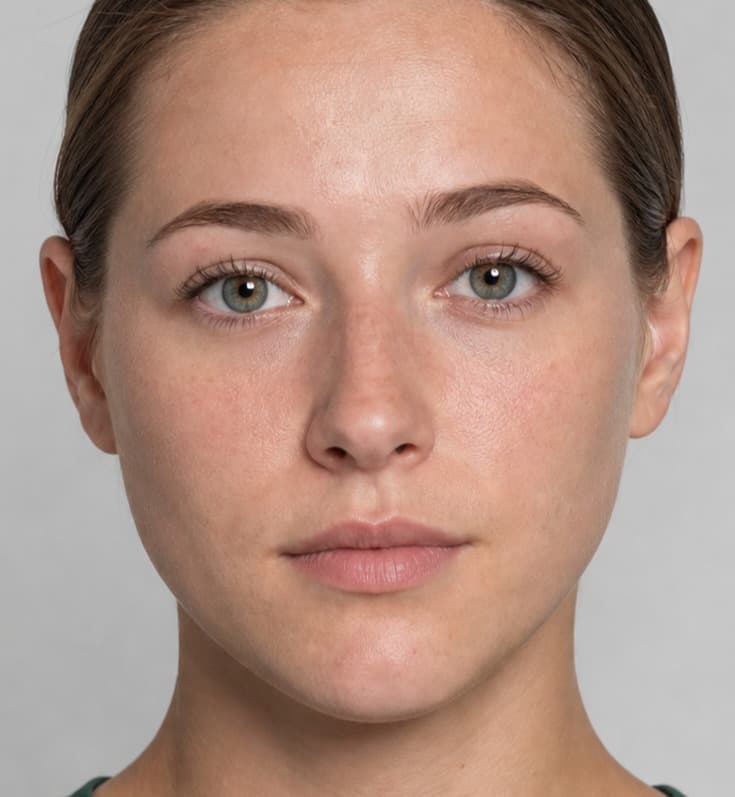
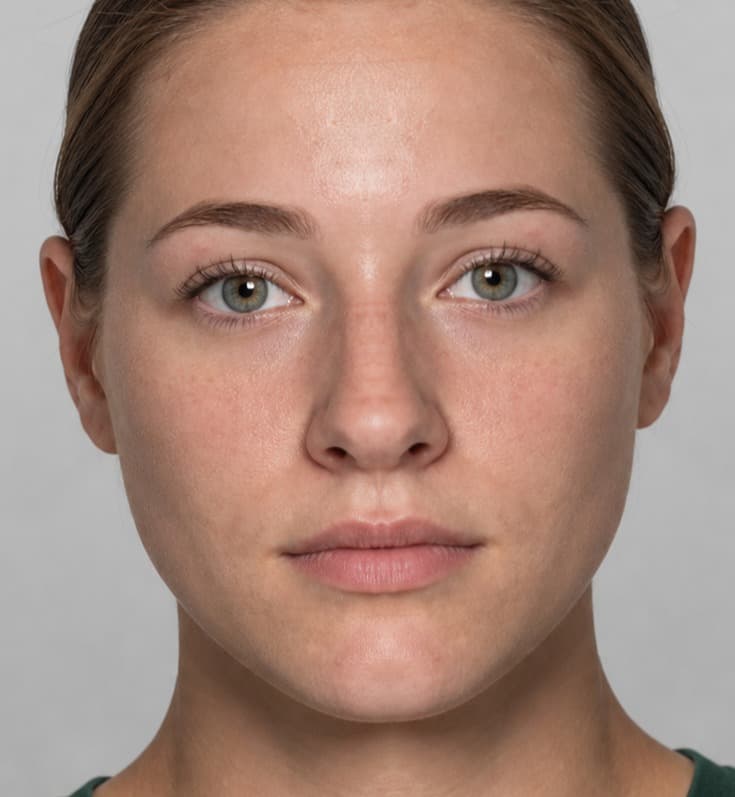
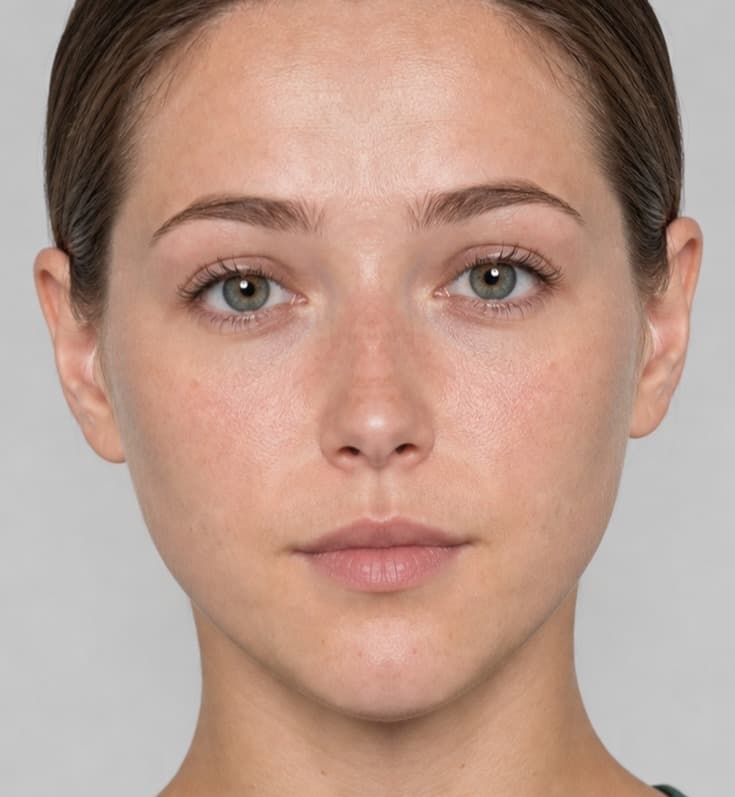
Two faces, both built entirely out of one person. Neither is how anyone sees her — the composites double every difference — but the gap between them is her asymmetry, made visible without a single number.
Average deviation
1.2%
of face width
By region, largest first
- Jaw largest
- 2.4%
- Mouth corners
- 2.1%
- Nostril edges
- 0.9%
- Brows
- 0.5%
- Outer eye corners
- 0.1%
The ordering is the part that holds up. That her jaw misses by more than twenty times what her outer eye corners do is a fact about her face, measured directly from this photo.
How to check face symmetry without a tool
You do not need software for a usable answer. Three methods, in order of how much they tell you.
1.Flip the photo
Take a front-facing photo and look at it, then mirror it horizontally and look again. You have spent your life seeing your face in a mirror, so the flipped version is the one closer to what you are used to and the unflipped one is what everyone else sees. Whatever jumps out when you switch between them is your largest asymmetry.
2.Draw the midline
On the same photo, draw a straight line through the middle of the bridge of your nose, tilted to match the line of your eyes rather than straight up and down. Then check each pair against it in turn: brows, outer eye corners, nostrils, mouth corners, jaw. Working pair by pair stops you from forming an overall impression before you have looked at anything specific.
3.Cover one half
In a mirror, cover one half of your face with your hand, look, then swap. This is the low-tech version of the mirrored composites and it isolates each side the same way, without exaggerating the difference the way a doubled composite does.
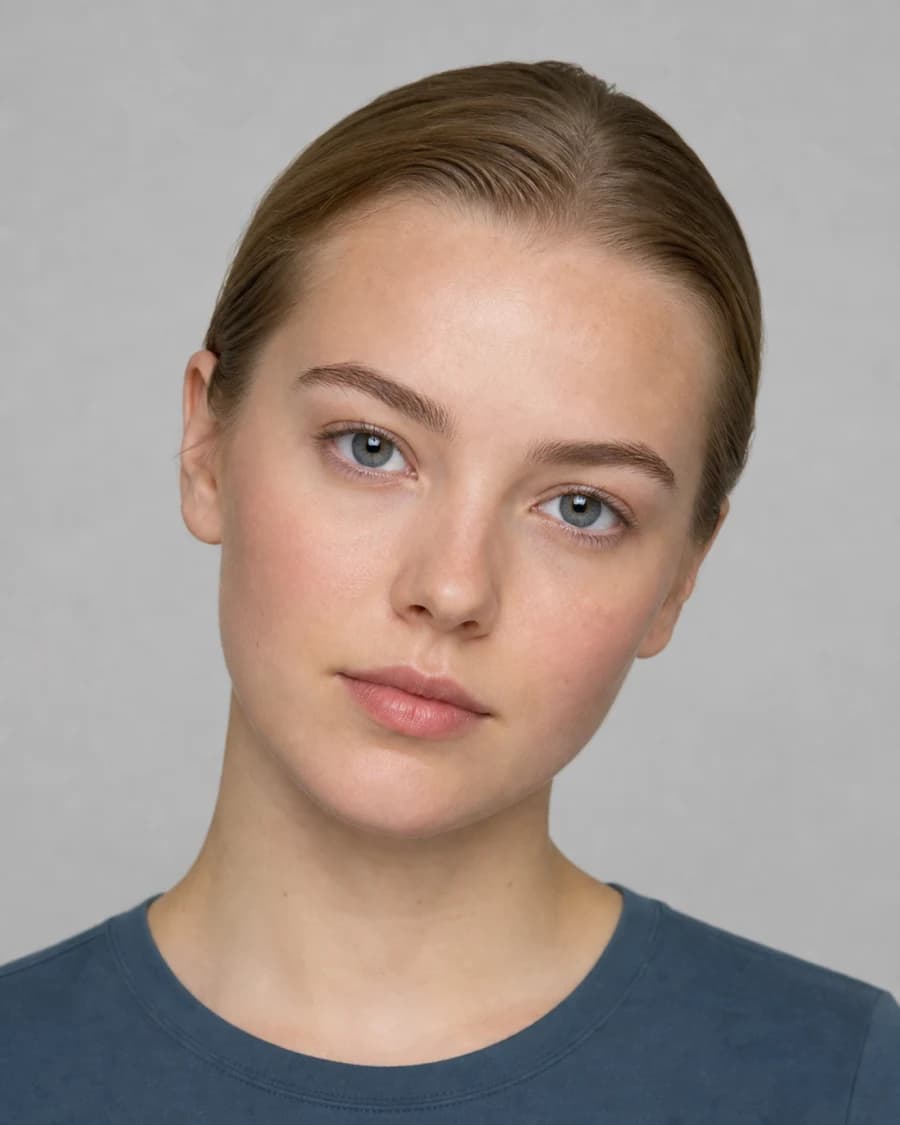
Vertical down the photo — misses the nose
Perpendicular to the eye line — the real midline
Doing this by hand and running the tool are worth combining. The hand methods tell you what is noticeable to a person looking at you, which is the question most people are actually asking. The tool tells you how large each difference is in proportion to your face, which the eye is bad at judging.
How a facial symmetry test measures a face
Every automatic face symmetry test does the same three things. It places landmark points on your face. It works out where the midline of your face is. Then it takes pairs of points that should mirror each other across that midline, measures how far each pair misses by, and averages the misses into one number.
The second step is where tools quietly differ, and it matters more than the first. The cheap way to find a midline is to assume the photo is upright and treat the vertical center of the face box as the axis. Do that and every head tilt gets scored as facial asymmetry, because a tilted face genuinely is asymmetrical with respect to a vertical line. Tilt your head five degrees between two photos and your score moves, with nothing about your face having changed.
This tool builds the axis from your face instead of from the photo frame. It takes the center of each eye, draws the line between them, and uses the perpendicular bisector of that line as the midline. The axis leans when your head leans, so the measurement follows your face rather than the camera. Then each left-side point is reflected across that axis and compared against its right-side partner.
The five pairs that get compared
1.Brow
The inner-to-mid brow point on each side. Brow height is the pair most often moved by expression rather than by structure.
2.Outer eye corners
Measured at the outer corner rather than the eye center, because the eye centers are what define the midline in the first place and would score a perfect zero by construction.
3.Nostril edges
The outer edge of each nostril. Nose deviation is the pair people most often notice in their own photos.
4.Mouth corners
The pair most sensitive to a half-smile, which is why a neutral expression gives a reading you can repeat.
5.Jaw
A point on each side of the jaw below the ear. This pair carries most of the underlying bone asymmetry, and also most of the error when the head is turned.
Each miss is divided by the width of your face before it gets used, so the result is a proportion rather than a pixel count. A ten-pixel offset means something very different on a face that fills the frame than on one shot from across a room, and dividing it out makes the two comparable.
The five proportions are then averaged and mapped onto a 0 to 100 score. That last mapping is the weakest link on this page, and the section on scores below explains why.
Your face symmetry checker, left and right
The score is an abstraction. The mirror halves are not. Take the left side of your face, reflect it across the midline, and join it to itself, and you get a face made of two left sides. Do the same on the right and you get a second face. Both are built entirely out of you, and most people find they look like two different relatives.
That gap is the clearest picture of your own asymmetry you can get, and it needs no calibration, no reference population and no threshold to interpret. You are not comparing yourself against anyone. You are comparing you against you.
It is also worth knowing what the composites are not. They exaggerate. Joining a half to its own reflection doubles every deviation, so a face that reads as slightly uneven in a photo can read as clearly uneven in the composites. This is the same effect behind the mirrored-face clips that circulate as a filter or a meme. It makes small differences visible, which is the point, but it is not a preview of how anyone else sees you.
What is a good face symmetry score?
This is the most common question in this category, and the straight answer depends on what your number is compared with. This tool compares your average gap with 1000+ reference faces measured the same way, so your result shows where you sit among them. A number from another tool sits on that tool's own scale and needs that tool's reference faces to mean anything.
A symmetry percentage is not a shared unit. Two tools that pick different landmark pairs, weight them differently, normalize by a different width or draw the midline a different way will hand the same photo two different numbers, and both can be internally correct. A 92 from one site and an 85 from another are not eight points apart. They are on separate scales with no conversion between them.
People often arrive here holding a number from somewhere else and wanting it decoded. The honest decoding is that the number described one run of one algorithm on one photo. It is not a property of your face the way your height is a property of your body.
The score on this page has the same limitation and we would rather say so. The measured deviations are real, and they are reproducible: give this tool the same photo and it returns the same proportions every time. The step that turns those proportions into a score out of 100 uses a constant we picked before having real photos to set it from. Until enough have come through, treat the score as a rough band, not a rank.
What the number is good for anyway
Comparing your own regions against each other
If your nose deviation is triple your brow deviation, that ordering is a genuine finding about your face and does not depend on the calibration at all.
Comparing two of your own photos taken the same way
Same lighting, same distance, same neutral expression, and the difference between the two readings means something.
Sanity-checking what you think you see
People routinely believe one specific feature is badly off and find their largest measured deviation somewhere else entirely.
Seeing roughly where you sit
Your result compares your average gap with 1000+ reference faces measured by this same tool, and shows what share of them your face is more even than.
Read that share as a rough position. It is rounded to the nearest 5 percent, so two results a few points apart describe the same place.
Why the same face gets two different symmetry scores
Run any face symmetry test twice on two photos of the same person and the results will differ, often by more than the difference between two people. This is the single most useful thing to understand about the category, because it explains nearly every confusing result.
A face is a three-dimensional object and a photo is a flat projection of it. Turn your head a few degrees and the far side of your face is compressed by the projection, which moves the jaw and nostril points on that side inward. The measurement is correct about the photo. The photo is simply no longer a fair view of the face.
What moves the reading, and what to do about it
Head rotation, the big one
A small turn toward one shoulder shortens one half of the face in the image, and the jaw pair takes the hit first. Face the camera straight on, with both ears equally visible.
Head tilt
The midline is built from your eye centers, so the tool follows a tilted head by design, but a large tilt still costs accuracy at the edges of the face. Keep your head roughly level.
Camera distance
Close-up phone shots exaggerate whatever is nearest the lens, so a face shot at arm's length and the same face shot from two meters do not produce the same proportions. Shoot at eye level, arm's length or further.
Expression
A half-smile, a raised eyebrow or a jaw set slightly forward all move the mouth and brow pairs, and they are asymmetry, just not the structural kind you were asking about. Neutral, mouth closed.
What the model can see
Landmarks get placed where there is a visible edge, so side lighting makes the shadowed side read differently. Use even, front-on light, pull hair back from your jaw and brow, and take off glasses that sit across the outer eye corners.
Facing the camera
Turned a little
This tool refuses to score a photo that is turned or framed too far off, rather than returning a confident number from a bad input. A rejection is more useful than a wrong answer. And if you plan to compare two readings later, write down how you took the first one: reproducing the setup matters more than perfecting it.
What this face symmetry test will not do
It will not diagnose anything
It measures distances between landmark points in a photo. It cannot see nerve function, bite, breathing, or anything under the skin, and a symmetry score is not a screening result.
It will not settle a disagreement between two other tools
If three sites gave you three numbers, all three may have measured correctly against three different definitions.
It will not tell you your face is good or bad
Symmetry is one measurable property of a face. What that property is worth is not a measurement question, and any tool that answers it for you has stopped measuring.
Questions people actually ask
Now do it with your own face
You have read what the number can and cannot tell you. The part worth having takes one photo: which of your five regions is furthest off, and the two mirrored halves that show it.
Upload a photoAfter the symmetry test
The rest of your facial measurements
Jawline, eye area and overall harmony, measured from the same photo.
What face shape the same photo gives you
The seven-shape classification, the ratios behind it, and why the boundaries are conventions rather than facts.
What your score means on the PSL scale
How the 0 to 8 rating system works, and where symmetry sits inside it.
Check your lip shape and lip symmetry
Compare the two sides of your mouth, plus lip thickness and Cupid's bow, from a relaxed photo.
Eye tilt and canthal angle
The slope of each eye in degrees, from the same kind of front-facing photo.